




handbook
Everything worth knowing before you build something nobody asked for. Rules, timings, and how to take part.


start here
Useless Projects is a build sprint about making something purely because you want to, not because it solves anything.
New here? Read this page top to bottom once. It covers everything you need before and during the hackathon.
how to participate
Registration is a single application, open to any student from a TinkerHub campus. Build solo or as a team.
- Apply on the hub appRegistration is through useless.tinkerhub.org, which opens the TinkerHub hub app. Any student from a TinkerHub campus can apply.guide: how to register for Useless Projects
- Go solo or bring a teamYou can participate on your own or as a team. Either way works, so pick whatever suits the idea you want to build.
- Prepare before the dayOnce accepted, start thinking through and preparing your project idea so you arrive at the venue ready to build.
what kind of ideas to build
Not “what problem are you solving”, but “what have you always wanted to make.”
Bring the idea you have always wanted to make and never had an excuse for, not a problem to solve. Small, working, and funny before it is clever beats big, half-built, and impressive on paper.
- the butterfly dress
- the portal
- the LED street fighter
to get started
No fixed minute-by-minute schedule. Venue-wise programs run their own version of the day.
Each venue runs its own program on the day; there's no single national schedule. Your venue host will walk you through timings, meals, and format when you arrive.
- Fork and clone the starter repoHere's the repo you'll build on top of.github.com/tinkerhub/useless_project_temp
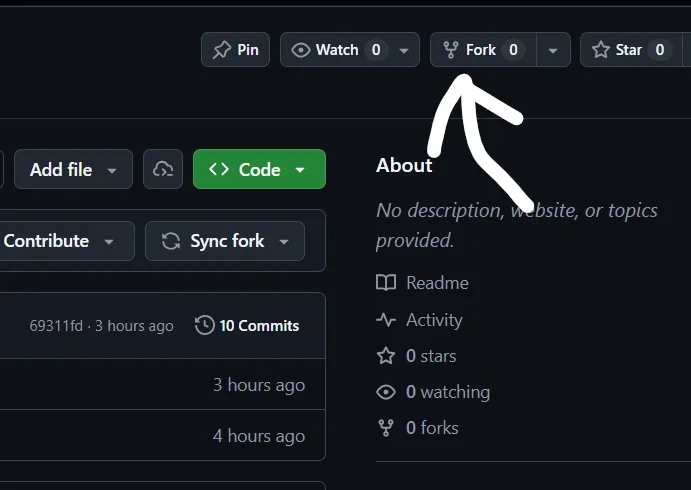 1. fork itHit Fork to copy it to your own account.
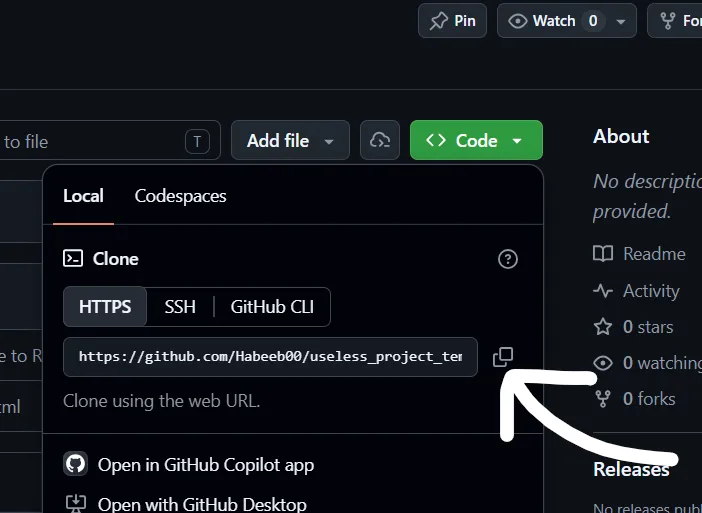 2. clone itHit Code, copy the HTTPS URL, and clone it locally.
- Keep an updated READMEKeep an updated README and a well-documented repo, so judges and other participants can find it.
Enjoy the process of making. Be kind, help the people stuck next to you, learn out loud, share what you know, and build.
who to talk to
Help comes from two rings: the room you're in, and the wider TinkerHub community.
Who's a mentor? Could be someone wearing a mentor badge, or it could just be the person sitting next to you. There is no such thing as a question too small; half of them will be about a cable.
- Your venue itself
- The larger TinkerHub community
- Campus team
- Foundation team

how to submit and get judged
Submission happens in the same app you applied through.
- Submit in the hub appSame app you used to apply. Update your README properly. If it's software, deploy it: a live link and a GitHub repo are needed. If it's hardware, an updated README with diagrams, photos, and videos is needed.guide: how to submit your project in the Hub app
- Venue-wise validated projects presentYour venue host reviews and validates submissions, then validated projects present at the venue.
- Community votingAfter presentations, voting is opened to the community.
- Venue-wise best projects shownOnce voting closes, the best projects at each venue are shown. There's no prize distribution at the venue itself.
- Foundation announces final resultsA few weeks after the hackathon, the Foundation reviews the venue-wise best projects and announces the final results.
Judging criteria: 60% Creativity, 20% Implementation Complexity, 20% Cross-Disciplinary Approach.
prizes
There is no scoring rubric worth defending, so here is roughly what impresses us, and what happens if it impresses us enough.
main quests
Hit these and you're in line for a real prize.
- top 25 makersThe 25 highest-scoring makers get a 6 month fellowship from a total pool of ₹5 lakh.
- top 50 projectsThe 50 highest-scoring projects get a showcase slot at Maker Faire Kochi.
- goodies bagSelected participants take home a goodies bag.
- mentorship & learning accessSelected participants get mentorship from industry experts and access to exclusive learning programs.




side quests
Smaller extras for specific things done well.
- video journalTop 3 get a ₹3,000 hardware kit eachknow more
- venue after-movieTop 3 venues get a ₹5,000 hardware kit eachknow more
- project journalTop 3 get a ₹3,000 hardware kit eachknow more
- best use of local LLMs₹2,000 worth of prizesknow more
- best pcb design / custom hardware₹2,000 worth of prizesknow more
- most complex 3d printed assembly₹2,000 worth of prizesknow more
- best reverse engineering / hardware hack₹2,000 worth of prizesknow more
- best interactive physical installation₹2,000 worth of prizesknow more
- best custom input device / alternative controller₹2,000 worth of prizesknow more
- best fashion tech & wearables₹2,000 worth of prizesknow more
- best superhero / sci-fi gadget₹2,000 worth of prizesknow more
- best game / interactive media₹2,000 worth of prizesknow more
- best retro-futurism / analog hack₹2,000 worth of prizesknow more
- best system integration₹2,000 worth of prizesknow more
- best bio / materials tech₹2,000 worth of prizesknow more
- most over-engineered solution to a non-problem₹2,000 worth of prizesknow more















- Commitment to the bit. A fully realised silly idea beats a half-built clever one.
- It works. Or it fails in an entertaining and clearly deliberate way.
- Craft. Whatever you're making, make it well.
- The demo. Well spent, in front of a room that wants you to succeed.
For both video journal and venue after-movie, you need to submit an application here.
the rules
Short list. We would rather spend the weekend building than adjudicating.
- Build during the event.
- Building with AI is welcome, as long as you learn and have fun.
- Be decent to each other. The code of conduct applies to the whole event, online and off.
Anything not covered here is decided by the organisers on the day, and we will always err towards letting you build the thing.
the fine print, shelved
We're a free community, but a free community still runs on ground rules. Here's where ours live.
- the shelfTinkerHub ShelfCode of conduct, privacy policy, and terms, all shelved in one place instead of scattered across three PDFs nobody opens. Skim it for the jokes, stay for the part that actually governs the event.
venue issues and emergencies
Anything about the venue, or any emergency, goes to the host or the organisers, not to us after the fact.
Any venue problem (power, seating, wifi, food, safety) or emergency during the event should be reported immediately to your on-site host or the organising team. The venue and host are the point of contact for anything happening live on-site.